• Home
    • Clearance Sale
    • Norvise
    • Fly Tying Kits
    • Fly Tying Materials
    • Hooks & Shanks
    • Tools & Fly Boxes
    • Gift Cards
    • Clothing
    • Commercially Tied Flies
    • Small Batch Flies
  • Guided Trips
  • Book A Presentation
  • Fly Tying Lessons
  • Blog
  • Calendar of Events
  • Podcasts
  • Contact Us
    • Our Story
    • About Bart Lombardo
  • Fly Patterns
  • Newsletter
  • Sign In My Account
Menu

Panfish On The Fly

PO Box 174
Clarksburg, NJ 08510
(609) 529-1729
Fly Fishing for America's Favorite Fish

Your Custom Text Here

Panfish On The Fly

  • Home
  • Shop
    • Clearance Sale
    • Norvise
    • Fly Tying Kits
    • Fly Tying Materials
    • Hooks & Shanks
    • Tools & Fly Boxes
    • Gift Cards
    • Clothing
    • Commercially Tied Flies
    • Small Batch Flies
  • Guided Trips
  • Book A Presentation
  • Fly Tying Lessons
  • Blog
  • Calendar of Events
  • Podcasts
  • Contact Us
  • About
    • Our Story
    • About Bart Lombardo
  • Fly Patterns
  • Newsletter
  • Sign In My Account

There is a New REGAL VISE in the House!

February 15, 2016 Panfish On The Fly

Regal Revolution with stainless steel jaws.

I recently picked up a new vise from REGAL VISE.  To date, I have done most of my fly tying on probably one of the most sought after vises  ever made - a LAW vise.  The value of the LAW vise has sky rocketed since they stopped being manufactured.  Not that they were ever really "manufactured"  in the sense of the word.  Each vise was hand made by a gentleman named Lawrence A. Waldren,  a British precision machinist  who, for a while, made a limited number of high quality tools for cane rod building and fly-tying.  He also made fly reels, which I understand are quite impressive. Every vise, as well as his other products, were individually made to order by Lawrence, and each one was characterized by a very high quality level in design, construction and materials.  It is without question the finest vise ever made.  

If the LAW vise is so great why stop using it?  I'll tell you...I do a lot of tying.  I am not a commercial tier but I tie a lot.  There are few flies in my boxes that have not been made by my own hands.  For over 15 years the LAW vise has been the only vice I tied on.  And I own quite a few high quality vises, Renzetti, Dyna-King, as well as two other REGAL vises.  They have been collecting dust on a shelf waiting for my two sons to show an real interest in fly tying (I'm happy to say that the Dyna-King Barracuda has found its way up to my 13 year old's room!).  As I mentioned earlier, the LAW vise is highly sought after and its no longer made.  That means its value keeps increasing.  In 2014 I was offered $3,800.00 for the vise at a show in New Jersey.  If the guy had cash instead of a personal check I probably would have sold it right then and there. Recently the price for these vises is nearing the $5,000 which is insane.  I don't know if the trend will continue but this may be something to put away or at least not wear out (though I doubt I could).

The big question was, what to replace the LAW vise with?  For me the answer was easy.  I own a number of high end vises that I could have brought out of retirement, but I had been longing for a particular vise for some time now.  The REGAL Revolution , particularly the model with stainless steel jaws.  Having owned  and used REGAL vises previously, I was very familiar with their hook holding power and ease of operation.  Even since purchasing the LAW vise REGAL vises have long been my vise of choice for spinning deer hair and salt water patterns where extreme hook holding power is important.  I also turn to a REGAL vise when I get into a "production tying" mood and need to turn out flies quickly.  The hook holding mechanism of the REGAL vises make them the fastest when it comes to setting and removing hooks. 

I have been using the new Revolution model for a couple of days now and I love it!  The stainless jaws are a big improvement for me over the standard jaws.  I can confidently say that with this new vise on my tying desk the LAW vise can start enjoying an early retirement.  Obviously a tool like the LAW vise is meant to be used and it still will be, but the REGAL is the new work horse.  REGAL Engineering did a great job designing this vise and the custom anodizing really makes it an attractive tool.  I'm looking forward to a lot of time spent behind it! 

Comment

Damsel Fly Nymph

February 6, 2016 Panfish On The Fly

A good damsel fly hatch.

Since all of my warm water haunts are not so warm this time of year, most of the blog posts over the next few months will be focused on fly tying.  One of my favorite fly patterns for panfish are damsel fly nymphs.  Damsel fly nymphs are probably some of the most productive nymph patterns I use on a regular basis.  They can be tied ornate or extremely simple.  For bluegill and other panfish I lean towards simple versions.  The adult insects pictured above are an important food source but fish are in contact with nymphs in various stages year round.  As an added benefit, they are the perfect pattern to present to fish when fishing from the shore.  Damsel flies spend the majority of there lives under water.  When they are ready to molt the nymphs will actively swim towards shore where they will crawl onto lakeside vegetation.  This shore bound migration is easily imitated when retrieving a cast fly back to shore.

  Once on dry land they split their exoskeleton, climb out of the shuck and emerge as an adult damsel fly.  After a short waiting period, as their wings dry,  they take to the air.  They will live for several weeks before returning to the water to mate and deposit their eggs on the stems of aquatic plants.  They are voracious predators in both the nymphal and adult forms.

Damsel fly emerging from nymphal stage (image from dkfindout.com)

Damsel fly emerging from nymphal stage (image from dkfindout.com)

Spent shucks on lake side vegetation.

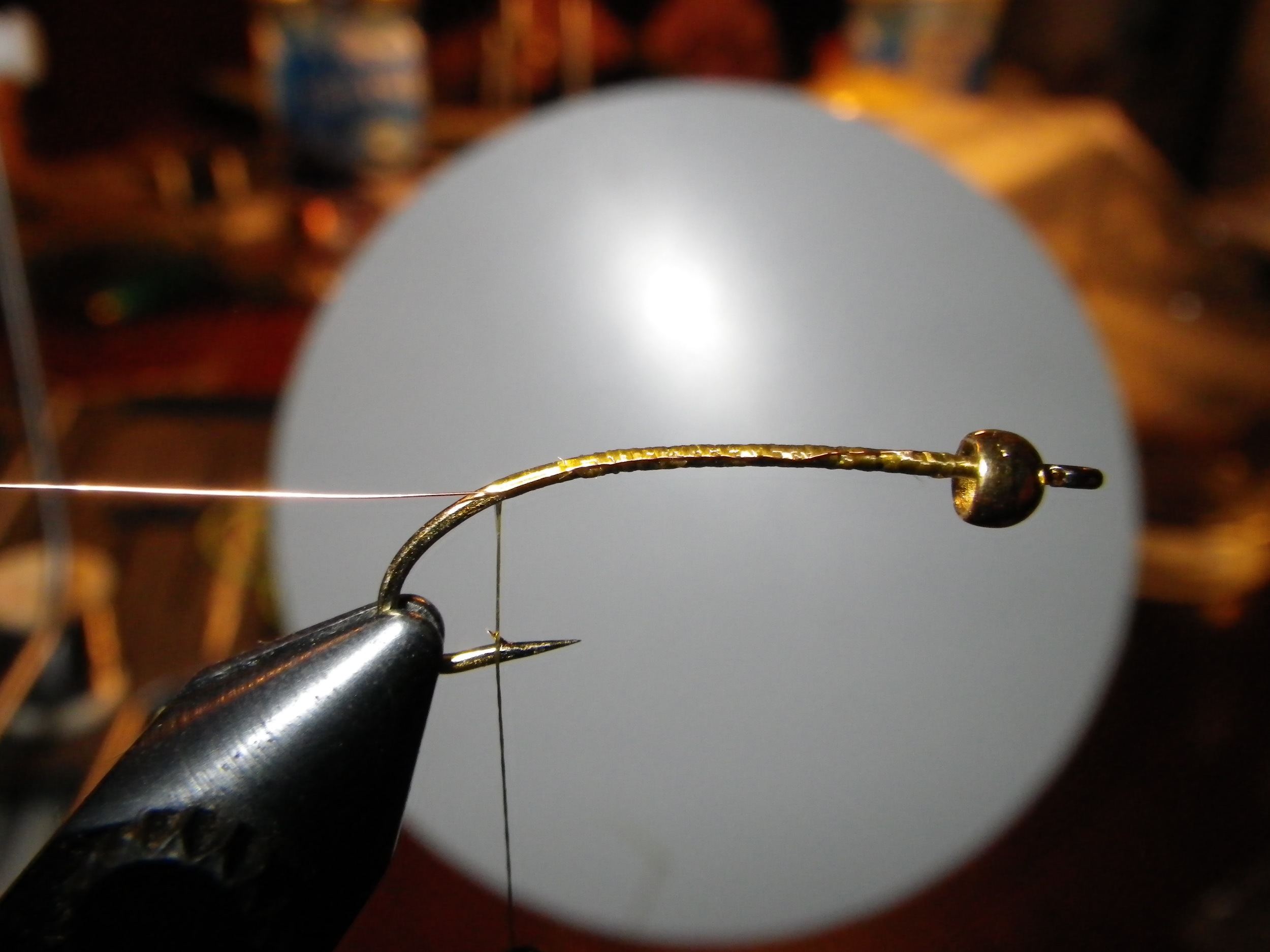
The pattern I am highlighting in this post is a simple one, only three materials if you don't count the hook its tied on.  Marabou in a color matching the nymph, a piece of wire for segmentation and a bead to provide weight and a proper silhouette in the water.  There are no wing buds, legs or mono eyes.  Very simple, very quick to tie and very effective.


Marabou Damsel Fly Nymph

Step by Step Instructions:

Mount bead on hookAttach threadWrap back to a point over the hook eye

Mount bead on hook

Attach thread

Wrap back to a point over the hook eye

Tie in gold wire

Tie in gold wire

Tie in the marabou feather for a tail leaving the waste end attched

Tie in the marabou feather for a tail leaving the waste end attched

Wrap the waste end of the feather up the hook shank and tie off behind the bead

Wrap the waste end of the feather up the hook shank and tie off behind the bead

Counter wrap gold wire, tie off and whip finish

Counter wrap gold wire, tie off and whip finish


In Fly Tying Tags Damsel Fly, Nymph
1 Comment

Tenkara Angler - Winter Edition 2015-16

February 3, 2016 Panfish On The Fly
Tenkara Angler Magazine

Tenkara Angler Magazine

Although I have not written about it on this site yet, I am an avid tenkara angler.   I first adopted the technique for fishing in cold water for trout, but I quickly saw it's value as a warm water fly fishing technique.   Using tenkara equipment and methods are one of my favorite ways to fish for panfish.  I will be writing more on the subject in the future, but until then check out this relatively new online magazine Tenkara Angler

This is the second issue of the Tenkara Angler to hit the digital news stands.  It contains over 100 pages of information on tenkara, including using the technique in warm water. In addition, you'll find information on fly tying, photographing and some non traditional methods of utilizing tenkara such as Czech nymphing (which is the reason I was first attracted to tenkara).   If you like what you read you can find the first issue here.

Comment

The Hot Butt Panfish Bug

January 25, 2016 Panfish On The Fly

A fine mess of Hot Butts

It's no secret that bluegills and other members of the sunfish family are attracted to color.  The exact color that turns them on may vary from day to day or even hour to hour.  In my neck of the woods, orange is a long standing favorite day in and day out.  This particular pattern was created during a tying session when I was refilling one of my still water, trout boxes with damsel fly nymph patterns.  I had just finished tying a few dozen damsel fly nymphs for my annual pilgrimage to Grebe Lake in Yellowstone National Park.  My tying desk was littered with 2x long nymph hooks, bead chain eyes and a material I was using to add legs to a new damsel fly nymph pattern I was experimenting with. Truth be told,  I could have simply continued tying the same pattern and throw some in my panfish box and call it day.  Damsel fly nymph imitations are some of my most productive sub surface bluegill flies.  

I had something different in mind.  I wanted to add a little bit of color to the fly and change up the profile a bit.  The olive marabou tail was replaced with a small tuft of UV orange marabou.  The slim marabou dubbed body was replaced by winding the polar chenille material I was using to imitate legs on the trout patterns.  The result was a fly that was incredible easy to tie, had a bright spot of color at the business end of the hook, had just enough weight to break the surface tension of the water and enticingly sink to the bottom and created a lot of movement in the water.  The UV olive brown polar chenille created a fly with lots of leg like appendages that move in the water even when the fly is slowly sinking or at rest.  Every twitch of the line brings the fly to life.  In addition to being an attraction to the fish, the orange tail works like a strike indicator under some conditions.  Panfish can be masters camouflage at times. In waters with certain bottom types, they are damn near invisible. Fortunately, over those same bottoms, the orange tail of this fly glows like a beacon.  I have often detected strikes when the little spec of orange I had been staring at simply disappeared.  When that occurs it is usually because a fish approached the fly from behind and sucked it in with out grabbing it and running off.  If I did not set the hook at the visual clue, the fish would have likely rejected the fly a split second later.  If I was not able to see that little spec vanish before my eyes I would have not been able to pick up on the hit.  Crappies are masters of this method of feeding.  Time and time again I have seen fish take these and other flies and have never physically felt the actual taking of the fly.

Many of my bluegill sub-surface patterns are tied on 2x or 3x long hooks.  I find that a longer hook helps when releasing the fish.  Bluegills and sunfish have very small mouths and removing a deeply set hook usually results in injury to the fish.  A longer hook often will be easier to I dislodge even when taken deeply by the fish.  The 2xl hook on this pattern fits the bill perfectly.

I have experimented with other colors for the body and tail and all have worked well, but the olive brown/orange combo is my by far my favorite.

Hot Butt in olive brown and orange

Tags Hot Butt Panfish Bug, Flies
Comment

The Willowfish Soft Hackle

January 11, 2016 Panfish On The Fly

One of many Crappie that fell to the Willowfish's charms

Okay, the name is strange.  I agree, but I can't change it.  The fly was designed and named by my son who was seven at the time.  As I was tying up some soft hackles and hot butt nymphs for a anticipated Hendrickson hatch my local trout stream, he sat down beside me and wanted to try his hand at fly tying.  Away went the drab olives and browns and out came the flashy steelhead dubbing.  Bright yellows, greens, purples and blues.  When we were done it looked like kaleidoscope broke open on the tying desk. Out of that colorful mess one fly stood out.  I tucked it into one of my panfish fly boxes and forgot about it.

The next spring while out on a local farm pond, I rediscovered the pattern tucked away in a box of experimental patterns.  I grinned as I tied the fly to the leader, recalling that winter afternoon watching my son whipping up some of the most outrageous looking flies I ever laid eyes on.  On it's maiden voyage it connected with a fish, then another and another.  After a half a dozen crappie in just about as many casts I clipped the fly off and tucked it back into the fly box.  I did not want to risk losing it before getting the chance to replicate it.

My son is thirteen years old now, so that means I have been fishing this pattern for nearly 7 years  It works as good today as it did on the first spring afternoon when I found it tucked into the corner of my fly box.

Tags Crappie, Soft Hackles
Comment
← Newer Posts Older Posts →
Summary Block
This block is invalid. Please check the block settings and try again.
Featured
Aenean eu leo Quam
Aenean eu leo Quam

Quisque iaculis facilisis lacinia. Mauris euismod pellentesque tellus sit amet mollis.

Read more →

FAQ AND CUSTOMER SERVICE

Contact Us

About

Book a Presentation

Calendar of Events


© Copyright 2026 Panfish On The Fly    All Rights Reserved

SUBSCRIBE TO OUR NEWSLETTER

Are you interested in learning how to tie a new warm water pattern each month? Do you want to know when new products arrive in the shop? Do you want access to special discounts and sales? Then SIGN UP now!

Subscribe

Sign up with your email address to receive news and updates.

We respect your privacy.

Thank you!